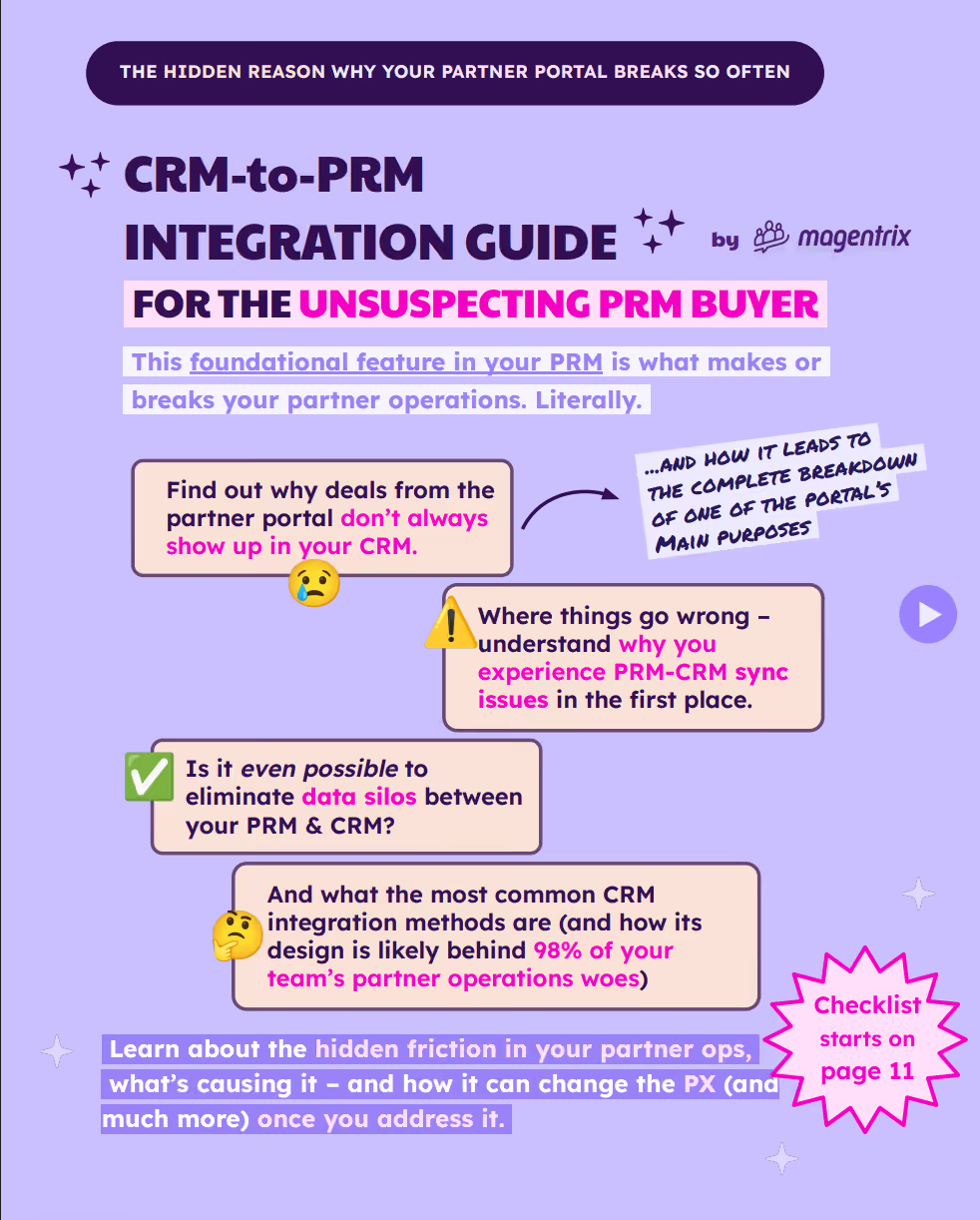
CRM integration is both the foundation of a PRM & the biggest blind spot in partner operations.
.webp)
Read the guide to understand why this happens, and how to avoid it altogether.




PartnerOps: are you babysitting your PRM instead of growing the partner program?
You get ahead in your job by being strategic about your partner operations. But the amount of maintenance work you have to deal with in to keep your PRM / partner portal workflows running is keeping you in a reactive loop that never ends but only gets worse as your operations grow.
❌ Broken deal registration workflows renders your portal useless
As the partner operations guy, the errors causing disorganized data across your CRM & PRM turns you into a full-time manual sync surgeon. This isn't what you signed up for. And when the portal fails at deal reg often, your partners may email you instead – or they may go elsewhere.
❌ Doing manual updates & explaining delays to partners who notice sync errors before you do...
Due to outdated or inconsistent fields in Salesforce or the PRM – due to CRM schema changes triggering sync errors.
❌ You unknowingly make the wrong decisions based on outdated partner data.
You might prioritize partners who appear to be performing, while your top contributors get overlooked because their data didn’t sync in time. And when leadership asks for a forecast, you’ll be reporting on a version of reality that doesn’t actually exist.
A CRM-to-PRM integration is the most foundational part of your partner portal
Make sure it's done right by reflecting your CRM data & structure – exactly as you have it in the CRM – into your PRM. That's why we say Magentrix is an extension of your CRM (others may use that as a buzzword, but for us it has meaning).
✅ Preserves CRM business logic
Custom objects, validation rules, relationships — they all continue to work. This keeps your partner workflows clean, accurate, and compliant with your internal rules.
✅ No data rebuilding
You don’t have to recreate objects, fields, or relationships manually in the PRM — Magentrix automatically mirrors your CRM setup, saving huge amounts of time during implementation.
✅ Lower maintenance
When you make changes to Salesforce (e.g. adding new fields, objects, or processes), no need to rebuild it in your PRM — the mirrored configuration in Magentrix can be aligned with just a few quick adjustments.
✅ Faster launch & time-to-value
Since you skip complex re-mapping projects and data modeling, you can launch your partner portal much faster and start getting value sooner (unlike most other enterprise PRMs).
✅ Seamless partner experience
Partners see accurate, structured data exactly how you intended (e.g. deal registrations, statuses, updates). Giving them true transparency to your data.
✅ REAL real-time accuracy
The realest. Unlike other PRMs, because we mirror your data, not just map it, your portal is always up-to-date with Salesforce without lag, messy duplicates, or manual updates.
Channel operations pros & channel managers are in awe of how powerful our Salesforce integration is

Jayson Peterson
"The visibility in communication and the level of capability to Salesforce is unparalleled. PRM to CRM integrations can be a nightmare. With Magentrix, it was literally a couple of clicks. That was the thing that surprised me the most was how much we can get out of that integration to Salesforce and how much data we can get to our partners." (Source: Magaya case study)

Allen Dixon
“One of the things that we absolutely love about Magentrix is the two-way nature of it. Your integration with Salesforce was a huge plus. The ability for our partners to communicate with our Salesforce and for our Salesforce to communicate with our partners was a real driving characteristic." (Source: Ubicquia case study)

Alex Richards
On PartnerStack:
“When it comes to data-mapping, it became evident that it was almost impossible for certain components to be moved over from Salesforce to the PRM or vice versa. Whereas, Magentrix is a true extension of Salesforce." (Source: customer interview)

Koorosh Khashayar
11:11 Systems
“While multiple products evaluated had solid point solutions, none of them had the advanced Salesforce integration, digestible pricing models or the expertise to know how to manage our scaling channel partner program - this was something that only Magentrix offered."
(Source: 11:11 Systems case study)
FAQs about CRM-to-PRM integrations that the guide answers in-depth
What’s the difference between field-mapping and data mirroring in a CRM-to-PRM integration?
Field-mapping copies over specific, data fields that are pre-defined in the PRM (what fields can be brought over) and it doesn't at all account for copying over your CRM's schema (this causes major issues for companies with large-scale partner operations).
Data mirroring recreates your entire CRM schema – custom objects and all – instantly. It literally reflects over all the CRM data (and its schema) over. All you have to do is select which data points you want your PRM to refelct (usually takes 5-8 mins for you to do)
Field-mapping integrations are faulty, error-prone and break easily.
Mirroring integrations just work. [The guide explains why.]
Why do CRM-to-PRM syncs break so often – especially in enterprise Salesforce environments?
Because field-mapped integrations can’t keep up with changes in CRMs with millions of records, custom objects, complex hierarchies, and frequent schema updates. With most PRMs, every small tweak in your CRM risks a sync failure and forces manual, time-consuming (and sometimes costly) fixes. Mirroring CRM data &schema avoids all of that. [Learn how in the guide.]
What are the hidden maintenance and operational costs of poor CRM integration in a PRM?
When a PRM uses a fragile field-mapping integration with your CRM, every time:
- a new field is added
- an object changes
- or validation logic is updated in Salesforce
the integration can break.
Syncs fail silently or throw errors. Then technical admins have to step in to:
- diagnose the issue
- remap fields manually
- patch the workflow
- and test the fix.
These are the “clean-ups” you'll have to deal with. You’re forced into recurring remapping incidences, patching, and error triage. Meanwhile, partner teams deal with outdated data, missed leads, and reporting gaps. It’s expensive, and sometimes invisible.
It adds up fast — especially when your partner ops team becomes a full-time sync babysitter.
[The guide reveals what most buyers overlook.]
Why do PRM vendors say they integrate deeply with Salesforce, but still require custom workarounds?
Because their integration often stops at surface-level field mapping. They can't mirror schema, so you're stuck filling the gaps with manual processes. [We explain how to spot this in the guide.]
How does Magentrix’s mirroring approach eliminate sync errors and IT involvement?
By directly mirroring both CRM data and schema — keeping everything aligned in actual real time, without brittle sync logic or constant upkeep. [Explore how it works in the guide.]
How can I evaluate whether a PRM’s CRM integration is truly scalable and reliable?
Look for data & schema mirroring, not just field syncs. Ask how it handles millions of records, custom objects, and frequent changes — without breaking. [The full guide gives you a comprehensive checklist.]
Get the buyer's guide: Empower your team with better insights around the foundational feature in PRM ⬇
What happens next? You'll receive:
1. Instant access to the full guide.
2. Additionally, you'll get an email from fereshta.noori@magentrix.com with a link to the full guide + a shorter, shareable pdf version of it.